38th International Seminar on Architectural History
Baths, spas and health resorts between the 15th and 18th centuriesVicenza, Palladio Museum, 26-27 May 2027Organised by Deborah Howard and Susanna Pasquali
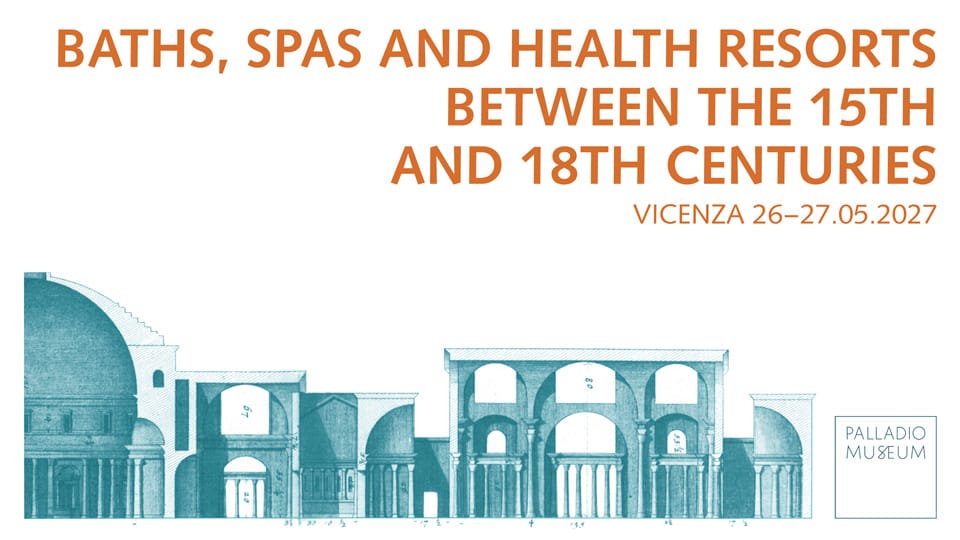
The practice of bathing at different temperatures has existed ever since mankind began using natural thermal springs. Through the development of efficient aqueducts and water-heating systems, the Romans were able to reproduce these benefits across the Empire, whether in public thermal baths or in private villas. In early modern Europe, the ruins of these structures had a dual impact: on the one hand, they bore witness to a culture of the body that had been lost; on the other, they were complex structures requiring careful observation to understand how they functioned. Innovations introduced over time in the fields of construction and hydraulics, underpinned by advances in medicine, led to the creation of physical spaces that became the settings for specific social rituals of bathing – initially reserved for the few but later extended to the many.
Against this backdrop, we propose a seminar that begins by examining the significance of the ruins of the thermal baths in the training and practice of architects between the fifteenth and eighteenth centuries. The baths of ancient Rome are therefore examined for their influence on subsequent architects, as seen, for example, in Palladio’s preparatory drawings for a book on the baths of antiquity, eventually published in England by Lord Burlington in 1730. The wealth of surveys, drawings and prints of these building types played an inspiring role in the design of large complexes of interconnected, vaulted spaces, even those not necessarily intended as baths.
Meanwhile, architects were incorporating baths into elite palaces (well-known examples include those in the Ducal Palace of Urbino, Cardinal Bibbiena’s ‘Stufetta’ in the Vatican Palaces, or the baths in the palaces along the Strada Nuova in Genoa). Projects of this kind, mainly carried out between the 15th and 16th centuries, combined an interest in antiquity – particularly through the study of Vitruvius – with advances in medical knowledge and innovations in hydraulic engineering. At the same time, natural springs, which had remained in use throughout the Middle Ages, gained increasing prominence, necessitating new and more modern facilities; visiting these became a shared social practice. Finally, during the 18th century, in the light of social changes, further initiatives were made to build thermal baths within towns for a wider public: a revival of a building type which, reintroduced centuries later, still drew on ancient prototypes.
The widespread adoption of a new culture of the body in the 19th century, and consequently the numerous thermal baths and spa facilities catering to the general public, fall outside the scope of this study.
